

Each year in June, the Center celebrates Dairy Month by offering posters, information cards, and other materials promoting dairy to dairy farm families to share within their local community. Our theme this year centers around America’s 250th anniversary and how many of our dairy farms are generational businesses that have been around a century or more. Pennsylvania has 4,360 dairy farms across the Commonwealth, and more than 93 percent of them are family-owned businesses.
It’s a unique heritage we have in Pennsylvania. If you travel to the Midwest, most of those farms started in the early 20th century. They consider five generations impressive. Here we have a few farms that are in their tenth or even eleventh generation. Have you ever considered what it takes to pass a business down through eleven generations? We often hear about the 30-13-3 rule, which is based on 30 percent of family businesses making it through a second generation, 13 percent making it through the third, and only 3 percent making it beyond a third generation.
It doesn’t surprise me that Pennsylvania has many dairy farms among the few that have made it to more than three generations. When you research early-America history, those who lived in those early settlements faced harsh survival conditions, economic hardships, constant threats, and the need to be self-sufficient. In many ways, dairy farm families today face similar conditions at any given moment in their operation.
Characteristics Transcend Centuries
Just since last June, we had severe rains in the summer, extremely cold weather to deal with in the wintertime, and a dramatic downturn in the dairy economy earlier this year. We faced the very real threat of Highly Pathogenic Avian Influenza inflicting dairy herds in other parts of the country and now are looking down at the barrel of the New World Screwworm crossing the border in Texas. All along, dairy farm families must continually think through ways to become more self-sufficient, with our dairy infrastructure now stretched across broader distances than ever before in our state.
Another key characteristic of early settlements, especially in Pennsylvania, was their pursuit of religious freedoms. Those early settlements were centered around faith and community. I often wonder how you could possibly be in farming today without a strong sense of faith. We invest in seed and fertilizer without knowing whether we will get a crop. We invest in good genetics and strict transition and early calfhood protocols without knowing whether that calf will ever make it to the milking parlor. We do everything we can to put our best foot forward, but in the end, it is up to Mother Nature and Father Time.
You also need to have a strong sense of community, recognizing that you alone cannot do everything. It takes relationships with those around you, your employees, your suppliers, your neighbors, and most importantly, your family members to build a business that can stand the test of time.
A Legacy to be Proud of
Back when our country was founded 250 years ago, almost everyone was a farmer. Many of those early farms had dairy cows. Colonists brought cattle from England, the Netherlands and other places across Europe, providing those pioneer families with life-giving sustenance and food security. These dairy farms served as a cornerstone in Colonial America, shaping the cultures, the economies, and the food systems in those early settlements. Today, only about 1 percent of our society is actively involved in production agriculture, let alone dairy farming.
Despite representing such a small minority, dairy farm families still provide food security and serve as a cornerstone in their local communities. Think about the wide open spaces and natural filtration your farm provides for the local environment. Think about the economic revenue your farm brings to the local community through the purchases you make and the tax dollars you bring in. Think about the milk you are producing. If it goes into fluid milk, it’s likely sold at a store less than 100 miles from your farm and feeds your neighbors. If it goes into butter, yogurt, ice cream, or other dairy products, it could be sold in that local grocery store or could move anywhere across the US to feed the world.
Dairy farm families also serve as cornerstones in our communities through the service roles we play. Look across township boards and planning commissions, church councils and cemetery boards, county conservation district boards and 4-H club volunteers, and you’ll often find dairy producers serving in those roles. Despite working long hours on the farm, dairy and other farmers are often the ones who show up when nobody else finds time and stay late long after everyone else has gone.
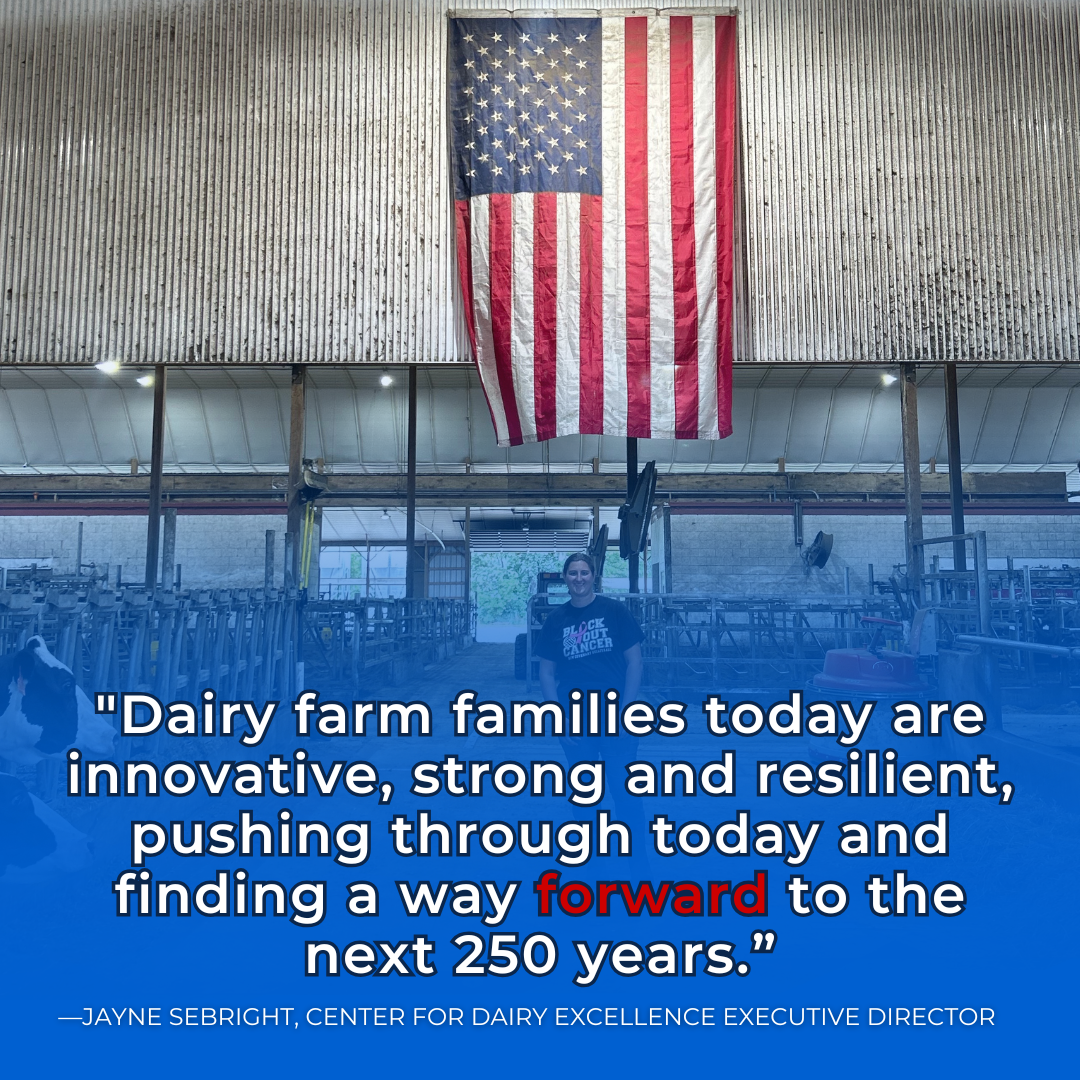
With this being June Dairy Month and our country’s 250th birthday, it is the perfect time to celebrate the many contributions our dairy industry, and specifically our dairy farm families, bring to Pennsylvania. Dairy farm families today are innovative, strong and resilient, pushing through today and finding a way forward to the next 250 years. You are the backbone of an industry generating more than $11 billion in annual economic revenue and supporting over 40,000 jobs across the supply chain. Remember, we are an industry that is “Farmer Strong and America Proud.”
Celebrate that legacy and share your story with the local community. If you want to order June Dairy Month materials from the Center to share at local events or on your farm, go to www.centerfordairyexcellence.org/june-dairy-month/. Limited supplies remaining.
Editor’s Note: This column is written by Jayne Sebright, executive director for the Center for Dairy Excellence.