
Depending on who you are talking to, the dairy industry is having a moment right now, or it is in serious peril. Honestly, depending on which data set you are looking at, both could be true. With the USDA opening its 2027 enrollment for the Dairy Margin Coverage (DMC) Program earlier this month, the DMC data shows the situation we are in for the short term.
From 2024 through mid-2026, DMC margins stayed consistently above the $9.50 maximum threshold the program has for indemnities month after month, with volatility in the all-milk price cushioned by lower-than-average feed prices. Since July, we have seen that starting to shift, with margins sitting mostly below $9.50 for the remainder of the year and for the first nine months of 2027. The latest USDA Milk Production Report shows 18 straight months of production growth, with the nation’s dairy herd now sitting at 9.71 million head, about 300,000 head above where we were five years ago and the largest herd we have seen in recent history.
The tight margins are weighing heavily on dairy farm families. There have been a few reports of herd dispersals but mostly farm families are just trying to figure out how to balance increasing costs, from fuel and labor to farm inputs and purchased feed, with a milk check that just doesn’t seem to go as far as it should. Despite a growing national herd, Pennsylvania has seen cow numbers declining over the past couple of years, down 9,000 head from two years ago at this time. Dairy farm numbers in Pennsylvania are falling, too, dropping 7 percent from 2024, while the number of cows on the dairy farm is increasing and approaching 110 cows per individual herd.
An Inflection Point
On the flip side, the most recent report has dairy companies across the US investing more than $15 billion in new dairy processing infrastructure in 19 different states, with $1.2+ billion of that in Pennsylvania. Much of the new processing infrastructure is in non-traditional products, like Greek yogurt, ultrafiltered milk, and specialized dairy ingredients. Surging demand for protein-rich products like cottage cheese and whey proteins are also driving new infrastructure, as America’s love affair with health continues to shift consumer demand.
Right now, our industry can’t get these products to market quickly enough. Demand for Greek yogurt is quickly expanding, with sales projected to increase 5 – 8 percent annually through 2030. Cottage cheese sales are up 82 percent from 2022, and surging demand for whey proteins have caused a shortage in that category, with whey inventories down 50 percent from 2023. New Federal guidelines prioritizing fuller fat and more nutrient dense foods like dairy have also provided more support for these growing markets.
In Pennsylvania, cooperatives and processors are struggling to navigate a shortage in the regional milk supply, with dairy farms navigating extremely tight margins. Most of the base excess programs placed on farms a few years ago have been lifted, with some farms slowly beginning to respond. With the recent announcement about the Chobani acquisition, many farm families are questioning how to weigh the potential long-term opportunities that could come with the short-term challenges that exist now. The risk of losing a market or having another base excess program come around also still weighs heavily on the minds of some.
Risk is nothing new to our industry. Anyone who has ever studied agricultural economics would remind us that the only thing that is certain in commodity markets, or in life for that matter, is change. We don’t know how long the low milk price cycle will last, or how quickly the increased capacity will create new demand and higher prices. We also don’t know how long the dairy herd will continue to grow with beef prices starting to slip. So, how do you weigh all these factors to make decisions about the future for your dairy? My recommendation is to first focus on drowning out the noise and to look solely at what is inside the control of your individual operation.
Where to Go From Here
What are your future goals for your operation? Where do you want to see yourself in 10 to 15 years? Do you have a next generation and where do their interests lie? How well can you continue to withstand the market downturn until prices rebound? Are there steps you can take to better position your operation to work through short-term challenges to capture long-term growth opportunities? What makes the most sense for your particular situation?
Every dairy farm family is going to have a different set of answers to these questions. And they have little to do with what your neighbor is telling you about milk prices or what you are reading about market demand or what the news is saying about the global economy. However, thinking through these questions can help you make decisions that can better position your operation for future success.
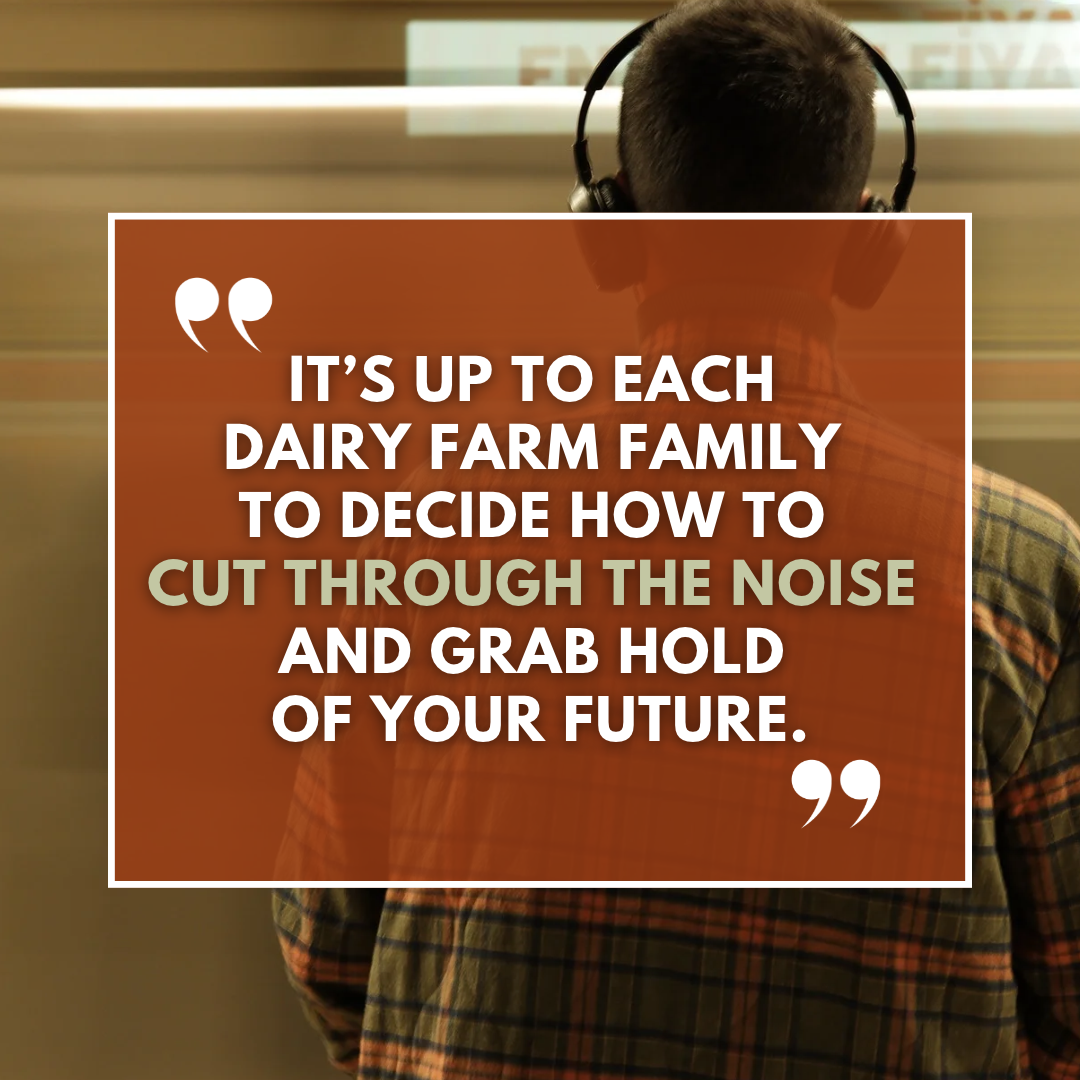
Right now, there is a lot of noise about dairy in Pennsylvania being at an inflection point, and that is certainly true. However, as leadership strategist Eric Sinoway once said, “Inflection points come in all forms, positive, negative, easy, hard, obvious, and subtle. The way you respond – whether you grab hold of an inflection point and leverage it for all it’s worth or just let it carry you along – is as important as the event itself.” It’s up to each individual dairy farm family to decide how best to cut through all that noise and grab hold of your future.
The Center’s consulting grants provide funding to bring in outside consultants who can offer objective perspective and a listening ear to help you think through your own personal situation and how best to move forward. Many of the producers who have used these programs in the past have told me that they really laid the foundation for where they are positioned today. Both our consulting grants and our reinvestment grants, which offer funding for small-scale reinvestments to support productivity, efficiency and cow comfort on the farm, are open for enrollment now. To learn more, go to www.centerfordairyexcellence.org/grants or call 717-346-0849.
The DMC program is a margin-based insurance program administered by the USDA’s Farm Service Agency (FSA). DMC enrollment for the 2027 program year will be open from October 5 to December 18, 2026. For farms that have never enrolled before, the DMC program is intended to serve as a safety net against volatility in either your milk price or in the price you are paying for your feed. Essential, it takes a little of that risk out of the equation. To learn more, contact your local Farm Service Agency. Or go to www.fsa.usda.gov.
Editor’s Note: This column is written by Jayne Sebright, executive director for the Center for Dairy Excellence.