

It is amazing how quickly things can change in dairy. Just two years ago, we were sitting at a $24.20 per hundredweight all-milk price with margins through USDA’s Dairy Margin Coverage Program at $14.20 per hundredweight. Despite the strong margins, USDA’s Milk Production Report showed total milk production down 1 percent from a year ago, with 12 months of stagnant to declining growth in the nation’s dairy herd. The nation’s largest dairy producing state, California, was down 9.2 percent in milk production year over year, with a lot of concern about the Golden State’s ability to rebound to year-earlier levels.
Today, USDA is reporting record growth in our nation’s milk supply, with September’s milk production up 2.7 percent, marking 19 months of US production growth. Cow numbers in the nation now are at 9.73 million head, the largest dairy herd in recent history, with more than $15 billion in processing capacity coming online to hopefully absorb that production growth. California has fully regained the milk production it lost in 2024 and is even higher in total production than it was in 2023. The all-milk price is sitting at just $19.91, with margins in October expected to be around $8.71 per hundredweight.
Something else has changed in the last two years. Think back on 2024 and why California was losing so much milk production. Do you remember what the major concern for dairy was in 2024? It was which state was going to be infected next with the Highly Pathogenic Avian Influenza (HPAI) in Dairy virus. During that time, there were a lot of discussions on how we were going to keep the virus away from Pennsylvania. Dairy farm families developed their biosecurity plans, cooperatives and processors began to collect milk tanker samples, and everyone stayed vigilant in keeping it out of our state. In February 2025, Pennsylvania became the first major dairy-producing state in the United States to be declared free of HPAI in its milk supply.
Since then, we have gotten more relaxed around biosecurity. But the threat of HPAI in Dairy hasn’t gone away. So far in 2026, 146 dairy farms have been affected, 46 of them in just the last 30 days. Cases have turned up in Kansas, Idaho, Utah, Texas, Washington, and most recently, Oklahoma. Getting a little closer to home, Indiana just announced its first case in the end of October, with two confirmed cases on dairy farms within that state. It takes less than four hours to get from Indiana to Pennsylvania. This is an important reminder for all of us that HPAI in Dairy is really only a truckload away from coming into Pennsylvania.
So, what are you doing to remain vigilant in protecting your herd? When HPAI in Dairy first emerged in April 2024, the Center held regular conference calls where Dr. Alex Hamberg, the State Veterinarian and Director of the Bureau of Animal Health for the Pennsylvania Department of Agriculture, and others shared guidance on how dairy farm families could best protect their herds against HPAI in Dairy and prioritize biosecurity in general.
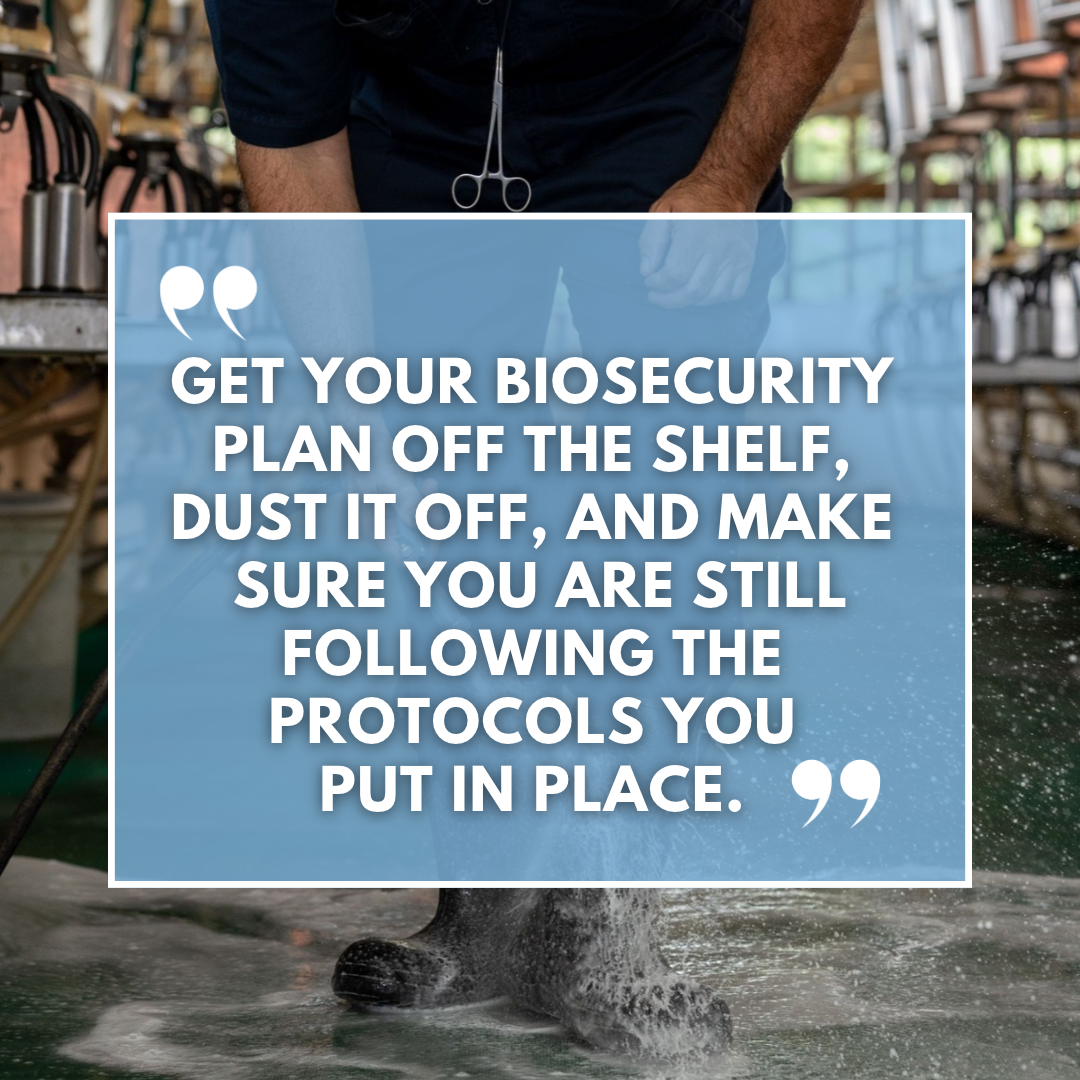
In one of those calls, he shared these simple tips:
- Keep a very close eye on animal movements. When animals are coming into your herd, that is a very high-risk situation. If they are coming from outside the state, make sure you are pre-testing them and that they are isolated for a few weeks after they move. Also make sure vaccination schedules are up to date.
- Step up the biosecurity. It may have not been on the forefront of dairy farmers’ minds. But biosecurity is still a priority. Look at how animals and equipment move and consider ways to make it safer for the animals and people on your farm.
- Know who comes onto your operation. Everyone who comes on your farm brings a level of risk, not only because of HPAI in Dairy but related to biosecurity in general. Understand who needs to come and who needs to be near the animals. And limit those who don’t.
- Look at wild birds and animals on your farm. Think about where those birds and animals are, and how you can limit cattle near those areas or how can you deter birds and wild animals from accessing places where your cattle are. If you can’t figure it out, call the Wildbird hotline at 833-PGC-WILD. Also, keep the farmstead clean.
- Just be prepared. Three big things you should have in place, just in case, are to prep those biosecurity plans, to identify what disinfectants you have on your farm and see which ones are EPA labeled, and do a little bit of human safety prep as well, just by having eye protection, gloves and masks on hand.
- Talk to your personnel. Do that education on your farm to make sure your employees know what the HPAI in Dairy virus is and what symptoms to look for. Talk with them to make sure they know what to look for and “to see something, say something.”
Have you taken steps to keep your dairy safe from HPAI in Dairy? Do you have a biosecurity plan? If so, how recently have you revisited it? Regardless of whether HPAI in Dairy ever comes to Pennsylvania, a good everyday biosecurity plan can save a dairy farm a lot of time, money and headaches. If you do have one, get it off the shelf, dust it off, and make sure you are still following the protocols you put in place. If you don’t have one, there are lots of resources to help you develop one. You can learn more about those resources by calling the Center’s Risk Education Program Manager Valerie Mason Faith at (717) 550-8720 or by emailing her at vmason@centerfordairyexcellence.org.
Editor’s Note: This column is written by Jayne Sebright, executive director for the Center for Dairy Excellence.