

Originally published in Hoard’s Dairyman
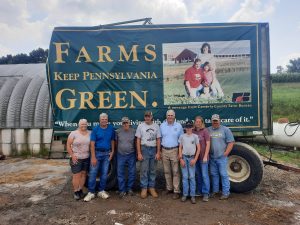
Chad Hoover sometimes farms with four generations working together at a time. As a sixth-generation dairy farmer at Thousand Hill Dairy, LLC in Cambria County, Pennsylvania, Chad realizes how fortunate he is to have a business and lifestyle that are rooted in family. His grandfather, father, and uncle are all still involved in the 200-cow dairy operation, and Chad’s eldest son marks the seventh generation.
“There can be some challenges working with family, but I’m the luckiest man alive. I get to work every day with my dad, my grandfather, and my son all together. My son was able to know his great-grandfather and grow up with him. That’s just a really rewarding experience,” Chad shared.
How have the Hoovers been able to build a family partnership that thrives financially with their bottom line always in mind? Chad says it starts with appreciating all the different generations and perspectives that are around the table to achieve a common goal – along with a lot of perseverance, sharp management practices, and consultants they trust.

Creating partnership agreements and finding a common goal
Part of working with family involves recognizing that everyone is working toward a similar goal. For the Hoover family, they started their family business transition process through a Transition Team Grant from the Center for Dairy Excellence. This grant paired them with a consultant from Horizon Farm Credit who helped the family navigate communication challenges, accounting best practices, and legal requirements.
“For us, the transition process has been kind of seamless. We all have our differences, but our common goal is wanting to see the farm continue. If you want to see the farm continue and you want to see the next generation take over, you have to be willing to let go of some of the reins,” Chad shared. “We all want the farm to be profitable, but at the same time, we all have our own ideas on how we want to do it. We have to find a line in the sand and be willing to cross it to keep everybody happy and minimize the amount of intolerance towards each other.”
The biggest piece of perspective their consultant added was third-party expertise and the space to help them reflect on past mistakes.
“By having an outside perspective [and consultant], you have somebody who has gone through it. When my dad and uncle went through a transition before me, it wasn’t as seamless. There was a lot of tension, and there’s a lot my dad and uncle learned from that,” Chad said. “It was nice to have another perspective from our consultant and a third party to say, ‘Hey, you guys need to take a step backwards before you take a step forward because here’s what could happen.’”
Their consultant also helped the family with complex, financial decisions when creating partnership agreements for the business. He also guided Chad through a plan for buying into the business every couple years.

“About every four or five years, I buy a certain percentage of the business. The consultants made the process a little bit easier. My dad and I each entertain side gigs outside of the farm operation which did create some tension. They helped us iron out those differences and lightened the mood in the room to make sure we all could come to some type of agreement on things,” Chad added.
With several family members still figuring out if they want to be part of the farm in the future, Chad and his family are open to adjusting the agreements over time and eventually forming an LLC that matches the desires of the next generation.
Making upgrades while keeping overhead costs low
With a shared goal of keeping the farm profitable, Chad and his family also keep a laser focus on only making manageable improvements that keep their bottom line in mind. When his dad and uncle first took over, they doubled the herd size. Building on that growth, Chad and his family have made additional improvements and investments over the last five years. They built two new calf barns to increase calf health, finished a heifer barn for breeding age up through springers, updated their parlor and went from six to a double ten, and installed Cow Manager tags to better monitor cow health.
“We’ve done a lot of upgrades, but at the same time, we’ve done most of it in-house. We received a few grants and things like that, but never took out a loan for anything. If we didn’t have the money to do it, we didn’t do it,” Chad explained. “We don’t have a lot of overhead. We’re not highly leveraged like other businesses can be when you’re looking at making those kind of improvements.”

So, how do they keep their overhead costs low? They work with an accountant they trust who challenges them to prepay when they can and evaluate which avenues are worth chasing.
“Our accountant, Kenny, does a good job and helps us make our mind up on a lot of different things. What can we do, or what shouldn’t we do? He’s always told me, if you can do something to improve the cows or increase your bottom line by making milk more cheaply, then those are the avenues you want to pursue. If it hasn’t increased our bottom line, then we haven’t really chased that,” Chad shared. “We’re also able to prepay seed, chemicals, fertilizer, and other inputs which allows us to take advantage of year-end discounts and specials.”
Keeping bottom line in mind with farm-level decisions
With animal care having a major impact on the farm’s bottom line, Chad is always trying to keep profitability in mind while improving cow comfort. He shared a few examples of farm-level and herd management decisions that are intertwined with their bottom line:
- Tweaking herd management strategies and certain facilities. “A couple years ago, we lost a lot of calves due to respiratory problems. We all know if you do a good job raising calves, they last longer in the herd. That’s why we made the decision to upgrade our calf facilities. Now we’re kind of at the point where we’re not necessarily getting a lot of growth on some of our heifers, due to overcrowding. So we’re breeding them later to make up for loss of growth, which resulted in us building another heifer barn for breeding age to springers. We are looking to increase the herd or else we would have just sold a bunch to reduce overcrowding.”
- Using technology to catch health problems. “When we first put Cow Manager in, we were dealing with heat detection challenges. We put the system in for the heat detection aspect but quickly utilized the rumination and cow health aspect of the program. Every time we found a sick cow, it felt like we were playing catch up. Now we’re catching those cows earlier and getting them into the sick pen and treating them if needed. For all-around cow health, we’re a lot better off than five years ago. We used to lose a few cows from time to time, but now that number is almost zero. We are also using less antibiotics because we are staying more on the preventative side.”
- Making culling decisions based on milk quality goals. “Over the past two years, we have seen a decrease in the number of mastitis cases due to culling decisions. I kind of made up my mind that I wasn’t going to do a lot of treating cows, unless she’s a really good cow. With an increase in somatic cell count in the summer, we use DHIA records to pinpoint the high cows and either treat or ship them. Sometimes I bite the bullet and get rid of the problem before it becomes more of a problem.”

The legacy he wants to leave
While Chad’s kids are still young and figuring out what their futures look like, he hopes to instill some of the financial and herd management lessons he has learned over time.
“My wife and I really enjoy milking good registered cows, but if my boys decide they don’t want to milk cows, that’s fine. If they do, I just want to give them the opportunity to farm, just like I had the opportunity from my dad and uncle,” he shared. “I want to instill in them that we can’t always spend, spend, spend and everything doesn’t have to be new paint all the time.”
As a dairy farmer, Chad says there’s no better feeling than getting up in the morning knowing he gets to work with his family to fine-tune their business and produce a wholesome product. For him, it makes all the troubleshooting of problems and persevering through difficult years more than worth it.
“As dairy farmers, we deal with a little bit of headache sometimes and barrel through it – hoping that on the other side, it’s a little bit better. It has been challenging for us but at the same time, we’ve gotten through it with a little bit of perseverance and God’s help. If you’re a dairy farmer, you chose to do that. I’ve chosen everything I’ve done in life. If I didn’t like farming, I wouldn’t get out of bed in the morning,” he added. “I know that we’re doing the best job we can do and providing a wholesome product for the consumer. I couldn’t ask for a better life.”